
Sussex County Probate Records
Sussex County probate court records are held at the Surrogate's Office in Newton, New Jersey. The county was formed on June 8, 1753, from parts of Morris County. Newton is the county seat. The Surrogate's Office stores wills, estate files, guardianship papers, and letters of administration for all of Sussex County. Probate court records here go back to 1753. You can search for records by calling the office, visiting in person, or using online tools. This page explains how to find and obtain probate court records in Sussex County.
Sussex County Quick Facts
Sussex County Surrogate's Office
Gary R. Chiusano serves as the Sussex County Surrogate. The office is at 3 High Street, Suite 1, in the Historic Sussex County Court House in Newton. Jeanne Woodhouse is the Deputy Surrogate. The office is open Monday through Friday from 8:30 a.m. to 4:30 p.m. There is reserved parking behind the Court House for those who visit in person. All probate court records for Sussex County are filed and kept at this location.
Sussex County was formed on June 8, 1753, from Morris County. It is one of the older counties in the state. The Surrogate's Office has kept probate court records since that year. The office handles wills, estate files, guardianship cases, letters of administration, and trust matters. Each filing creates a record that is stored at the Newton office.
| Office |
Sussex County Surrogate's Office 3 High St, Suite 1 Historic Sussex County Court House Newton, NJ 07860 |
|---|---|
| Phone | (973) 579-0920 |
| Fax | (973) 579-0909 |
| surrogate@sussex.nj.us | |
| Hours | Mon-Fri, 8:30 AM - 4:30 PM |
| Website | sussexcountysurrogate.com |
Note: Reserved parking is available behind the Court House for visitors to the Sussex County Surrogate's Office.
Sussex County Probate Court Records Online
The Sussex County Surrogate maintains a website with details for those who need to file or search probate court records. The site lists office hours, forms, and contact details. It is a good first step for any probate matter in Sussex County.
Below is a view of the Sussex County Surrogate's official website.
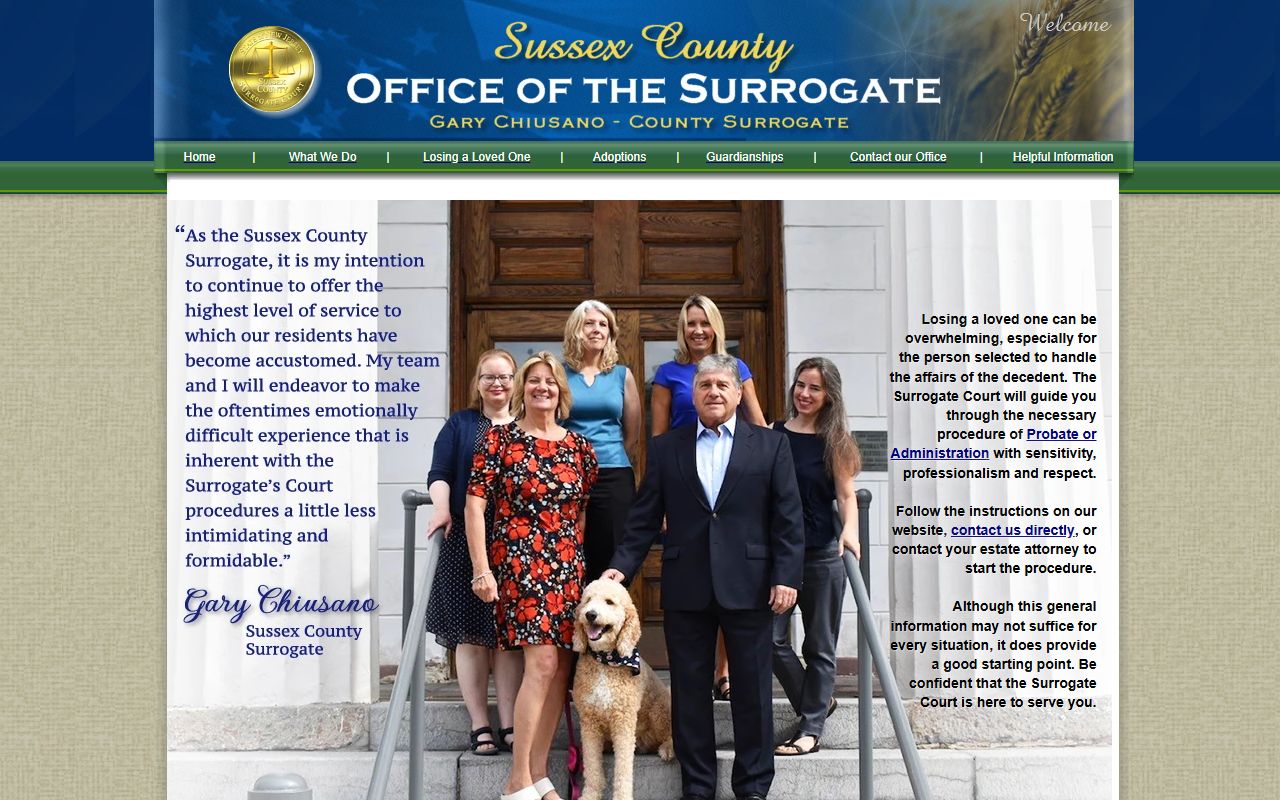
This site has forms and guides for wills, estates, and guardianship filings in Sussex County.
The Sussex County Surrogate also offers an online Court Index Search. This tool covers records from 1804 to 1974. You can look up names of those who filed wills or had estates processed in Sussex County during that span. It is free and can be used from home. The index is a strong starting point for anyone who needs old probate court records from Sussex County.
How to Search Sussex County Probate Court Records
There are three main ways to search for probate court records in Sussex County. You can call the office at (973) 579-0920 and ask staff to look up a name. You can visit in person at the Court House in Newton. You can also use the online Surrogate Court Index Search for records from 1804 to 1974. Each of these paths leads to the same set of Sussex County probate court records.
When you call or visit, bring the full name of the person and a date of death if you have one. Staff will search the index and pull the file. For records that are not in the online index, the staff in Newton can check the older books and files at the office. Sussex County probate court records are public. Anyone may ask to see them.
For very old records from the 1700s and 1800s, the New Jersey State Archives in Trenton holds microfilm copies. You can view them at the archives or order reels through interlibrary loan. The State Archives is a key resource for deep Sussex County probate court records research.
Sussex County Probate Filing Process
Under N.J.S.A. 3B:3-22, probate in Sussex County cannot start until the day after 10 days from the date of death. This waiting period is set by state law. Once 10 days pass, the executor named in the will can bring the paperwork to the Surrogate's Office in Newton. The process takes about 30 to 45 minutes when all documents are ready.
To probate a will in Sussex County, you need the original will, a death certificate with a raised seal, the names and addresses of the next of kin, and the filing fees. Fees range from $150 to $200. The base filing fee is $100 for two pages, plus $5 for each added page. Certified copies of probate court records cost $5 each. Under N.J.S.A. 3B:3-19, the Sussex County Surrogate has the power to admit a will to probate.
If there is no will, the estate is intestate. A family member can apply for Letters of Administration under N.J.S.A. 3B:10-1. You will need the death certificate, signed renunciations from other heirs, and a list of assets. Sections N.J.S.A. 3B:10-3 and 3B:10-4 set the order of who may serve as administrator. All filings create probate court records in Sussex County.
Note: The 10-day wait under N.J.S.A. 3B:3-22 applies to all estates in Sussex County. Plan to bring all documents to the Newton office after that period.
Sussex County Probate Records at State Archives
The New Jersey State Archives catalog for Sussex County lists a large set of microfilmed probate court records. These records span from the founding of the county in 1753 through the early 1900s. Researchers and genealogists use them to trace estates and family lines in Sussex County.
The State Archives holds Will Books from 1753 to 1922 and Indexes to Wills from 1753 to 1970. Orphans Court Minutes run from 1753 to 1902. Administration Bonds cover 1861 to 1908. Letters of Administration span 1804 to 1900. Guardian Bonds run from 1861 to 1904. Estate Inventories cover 1803 to 1903. Unprobated Wills span 1868 to 1940. These records form a deep collection of Sussex County probate court records for historical research.
Below is a view of the State Archives catalog for Sussex County probate records.
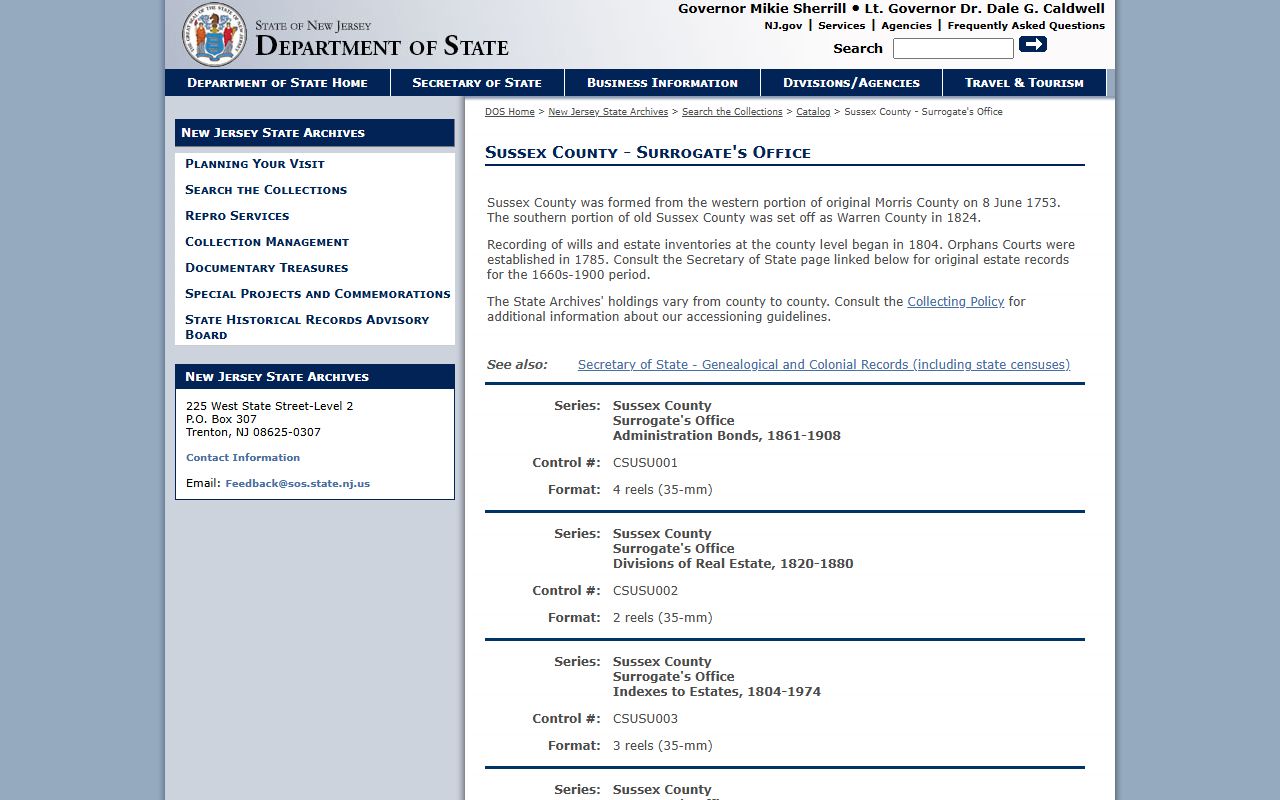
The archives staff in Trenton can help you find the right reels for your Sussex County records search.
Types of Probate Court Records in Sussex County
The Sussex County Surrogate's Office keeps many types of probate court records. Each type serves a role in the estate process. Some are filed at the start. Others come later as the estate is settled.
The most common probate court records in Sussex County include wills, letters testamentary, letters of administration, and guardianship orders. Wills show how a person wanted their assets split. Letters testamentary give the executor the right to act. Letters of administration serve the same role when there is no will. Guardianship records deal with the care of minors. Accounting records show how estate funds were handled. All of these are kept by the Sussex County Surrogate's Office in Newton.
- Last wills and testaments
- Letters testamentary and letters of administration
- Guardianship bonds and orders
- Orphans Court minutes and orders
- Estate inventories and accountings
- Unprobated wills
- Administration bonds
Sussex County Court Resources
The New Jersey Courts website has forms, guides, and contact details for all county courts. It is useful if you need state forms for probate court records in Sussex County. Forms for wills, letters of administration, and guardianship filings can be found there.
The New Jersey Legislature website has the full text of probate statutes. You can look up N.J.S.A. 3B:3-22, 3B:3-19, 3B:10-1, 3B:10-3, and 3B:10-4 to read the rules that apply to all Sussex County probate court records. These statutes set the process for wills, letters of administration, and small estate affidavits.
Historical Probate Records in Sussex County
Sussex County probate court records are a rich source for genealogical research. The county dates back to 1753. Its records at the State Archives reach back to that founding year. Wills from the 1700s list family members, land, livestock, and household goods. They name children, spouses, and sometimes neighbors. These details help build family trees and trace property in Sussex County.
The Unprobated Wills collection from 1868 to 1940 is a less known but valuable part of the Sussex County probate court records. These are wills that were written but never formally probated. They still hold useful information about family ties and assets. Estate Inventories from 1803 to 1903 list the personal property and debts of the deceased. Both sets of records add depth to any search through Sussex County probate court records.
Because Sussex County was formed from Morris County, any probate court records filed before June 8, 1753, are kept in Morris County. If your search leads to a date before that year, check Morris County records instead.
Nearby Counties
These counties border Sussex County. If you are not sure which county handles a probate case, check where the person lived at the time of death. The estate is probated in the county of residence. Each county has its own Surrogate's Office for probate court records.