
Search New Jersey Probate Court Records
New Jersey probate court records are kept by each of the 21 county Surrogate's Courts and by the New Jersey State Archives in Trenton. These records include wills, estate administration files, guardianship papers, and other court documents tied to how a person's assets are handled after death. You can search probate court records online through county databases, request copies by mail, or visit a local Surrogate's Court in person. Each county maintains its own set of probate filings, and some hold records that go back to the 1600s.
New Jersey Probate Court Records Quick Facts
Where to Find New Jersey Probate Court Records
Two main courts handle probate in New Jersey. The Surrogate's Court deals with uncontested matters. It exists in each of the 21 counties. The Superior Court, Chancery Division, Probate Part takes on contested wills, formal accountings, and guardianship cases for adults found mentally incapacitated. The Surrogate in each county serves as both a Constitutional Officer and Judge of the Probate Court, also acting as Deputy Clerk of the Superior Court. The New Jersey Judiciary maintains a full directory of all 21 county surrogates with phone numbers, addresses, and links to each office.
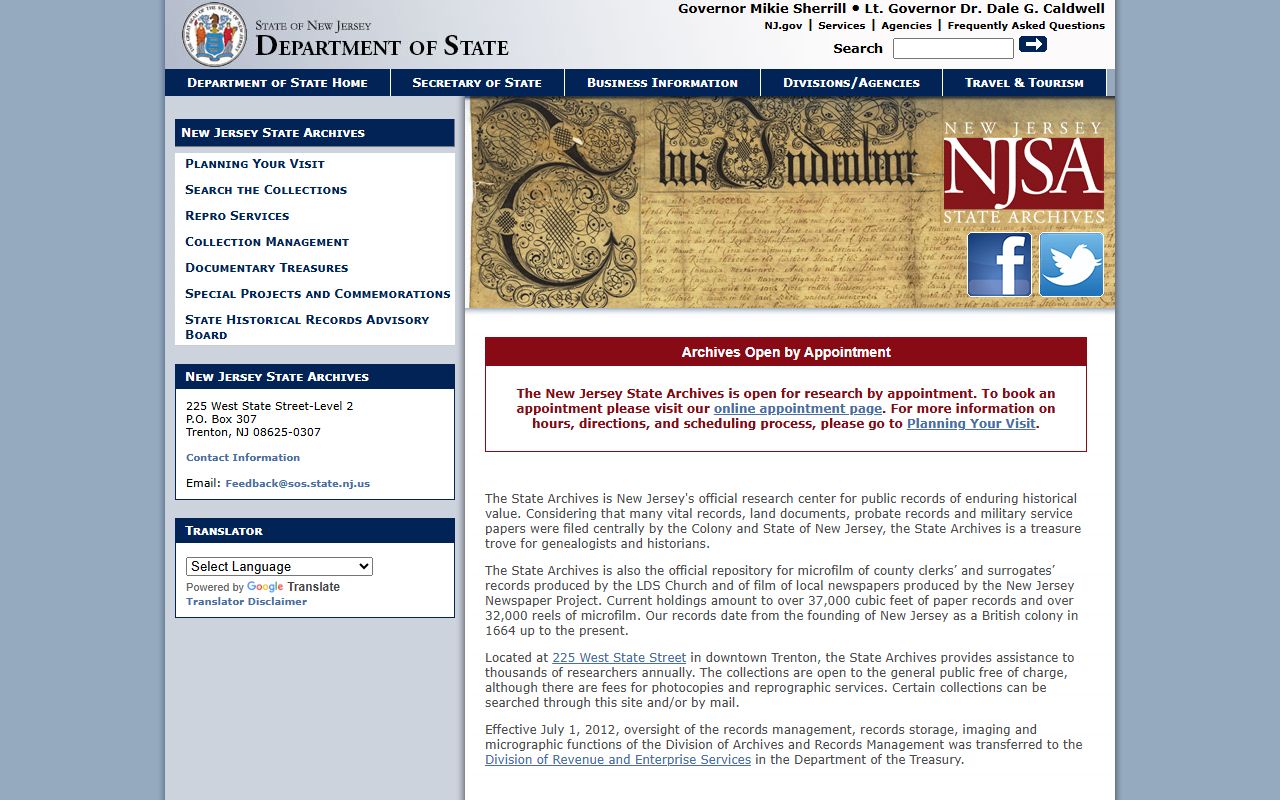
The New Jersey State Archives at 225 West State Street in Trenton holds original wills and probate records from 1670 to 1900 that were once with the Secretary of State. The Archives also keeps microfilm copies of many county surrogate records from before 1901. Collections are free to view in person. The Archives stores over 37,000 cubic feet of paper records and more than 32,000 reels of microfilm. You can reach them at nj.archives@sos.nj.gov for help with your probate court records search.
For records after 1901, the Clerk of the Superior Court Records Information Center in Trenton handles copies of wills, administrations, inventories, and guardianships. Contact them at P.O. Box 967, Trenton, NJ 08625-0967 or call (609) 292-4978.
How to Search Probate Court Records in New Jersey
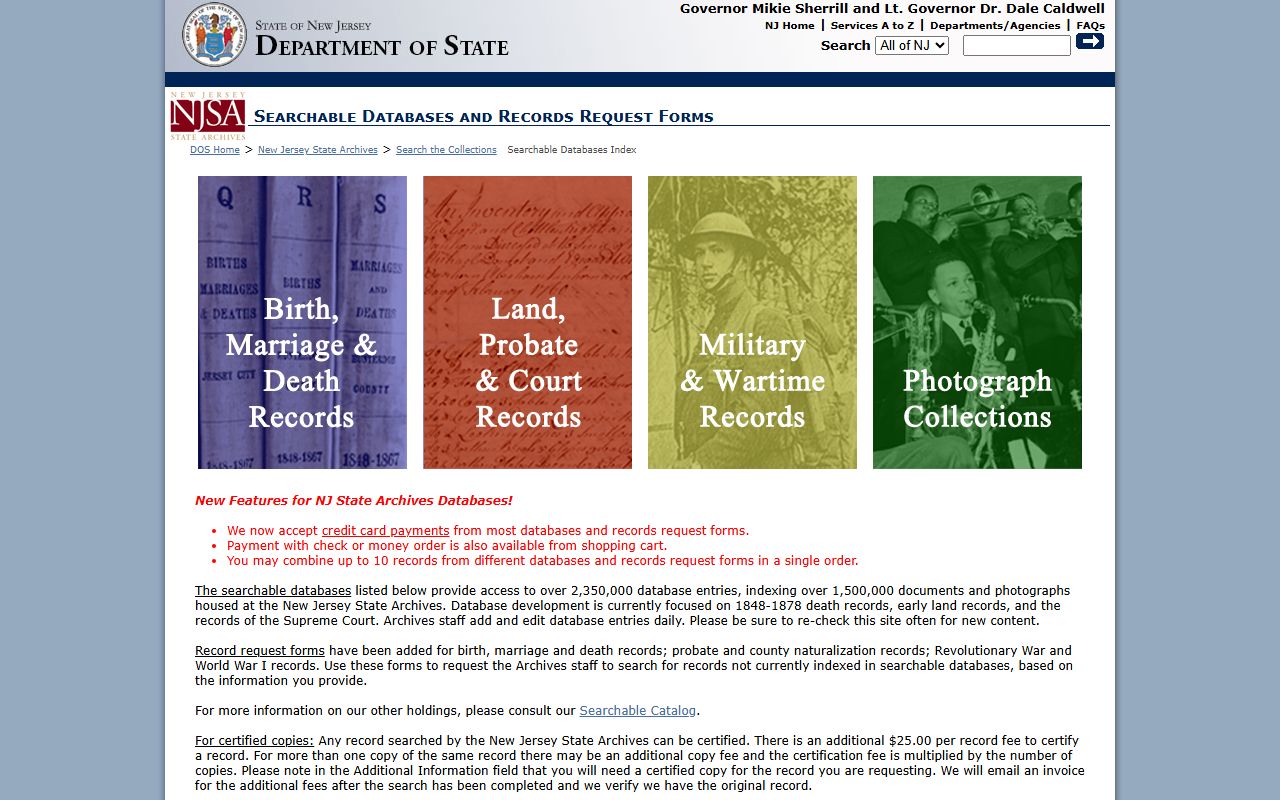
The State Archives searchable databases give you access to over 2,350,000 entries that index more than 1,500,000 documents. The Probate Record Search Request form covers records from about 1660 to 1952. You can combine up to 10 records from different databases in a single order. The Archives now takes credit card payments from most databases and request forms.
Several counties run their own online search tools. Middlesex County offers a free online estate index covering records from 1804 to the present. Burlington County has an estate index search on its website. Morris County provides an online estate search system at morrissurrogate.com for records dating back to 1804. These tools let you look up basic estate data before you visit or call.
You can also search in person at any county Surrogate's Court. Bring the name of the deceased and an approximate date of death. Staff will search the dockets and indexes for you. Some offices charge a small search fee, and copy fees vary by county. Most Surrogate's Courts are open Monday through Friday from 8:30 AM to 4:30 PM across New Jersey.
Note: Archives staff add and edit database entries daily, so check back often for new probate court records content.
Types of New Jersey Probate Court Records
Probate court records in New Jersey contain many types of documents. A will is the most common. It states how the dead person wanted their property split. Once a will is proved valid in court, it becomes a public record. Under N.J.S.A. 3B:3-19, the Surrogate's Court handles probate of wills in uncontested cases.
When someone dies without a will, the Surrogate's Court opens an administration case. Letters of administration give the appointed person the right to manage the estate. Under N.J.S.A. 3B:10-1, the court follows a set order to pick who serves as administrator. The spouse or domestic partner has first priority. Probate court records for these cases include the application, death certificate, bond, and letters issued by the court.
Other types of probate court records found in New Jersey include:
- Guardianship papers for minor children
- Guardianship filings for incapacitated adults
- Estate inventories listing all assets
- Executor and administrator accounts
- Bonds posted by fiduciaries
- Orphans Court minutes from historical cases
The Surrogate's Court also issues Short Certificates. These are official papers that prove an executor or administrator has the legal right to act on behalf of an estate. Banks, title companies, and other firms often ask for these documents during the estate process in New Jersey.
New Jersey Probate Laws and Statutes
Title 3B of the New Jersey Statutes Annotated sets out all probate rules. It covers wills, intestacy, and estate administration from N.J.S.A. 3B:1-1 through 3B:31-84. The law states that no will can go to probate until the day after ten days from the date of death, per N.J.S.A. 3B:3-22. This gives interested parties time to object.
New Jersey has a small estate process for simpler cases. Under N.J.S.A. 3B:10-3 and 3B:10-4, estates that do not exceed $50,000 may use an affidavit process when the heir is a spouse or domestic partner. For all other heirs, the cap is $20,000. This avoids the full probate court process and speeds up asset transfer. The New Jersey Court Rules for surrogate courts, N.J.R. 4:80-1 through 4:96-5, add more detail on how to conduct estate proceedings.

N.J.S.A. 3B:18-1 et seq. covers fiduciary commissions. These are fees that executors and administrators can charge for managing an estate. The amount depends on the size of the estate and the work involved. All commission requests become part of the probate court records filed with the Surrogate's Court.
Filing Probate Court Records in New Jersey
Probate is fairly simple in New Jersey. You do not always need a lawyer. The named executor brings the original will, an original death certificate with raised seal, names and addresses of next of kin, and two forms of ID to the county Surrogate's Court. The filing fee is $100 for a will up to two pages and $5 for each page after that. Surrogate's Certificates cost $5 each. Most people finish in under an hour.
If there is no will, the process is called administration. The filing fee for administration is $125. The applicant must bring the death certificate, renunciations from any parties with higher priority who do not wish to serve, and a list of the deceased person's assets with values. The Surrogate's Court reviews the papers and appoints the administrator. This usually takes 30 to 45 minutes at the office.
Note: Probate cannot be completed until the day following ten days after the date of death, though applications can be submitted earlier.
Historical Probate Court Records in New Jersey
New Jersey has some of the oldest probate court records in the country. The State Archives holds Prerogative Court records from 1670 to 1901, which include wills, administrations, letters of guardianship, and lunacy hearing records. The Prerogative Court served in an appellate role from 1784 to 1947. Indexes to state probate records from 1673 to 1901 appear in the "Index of Wills, Inventories, Etc. in the Office of the Secretary of State Prior to 1901," a three-volume set from 1912.
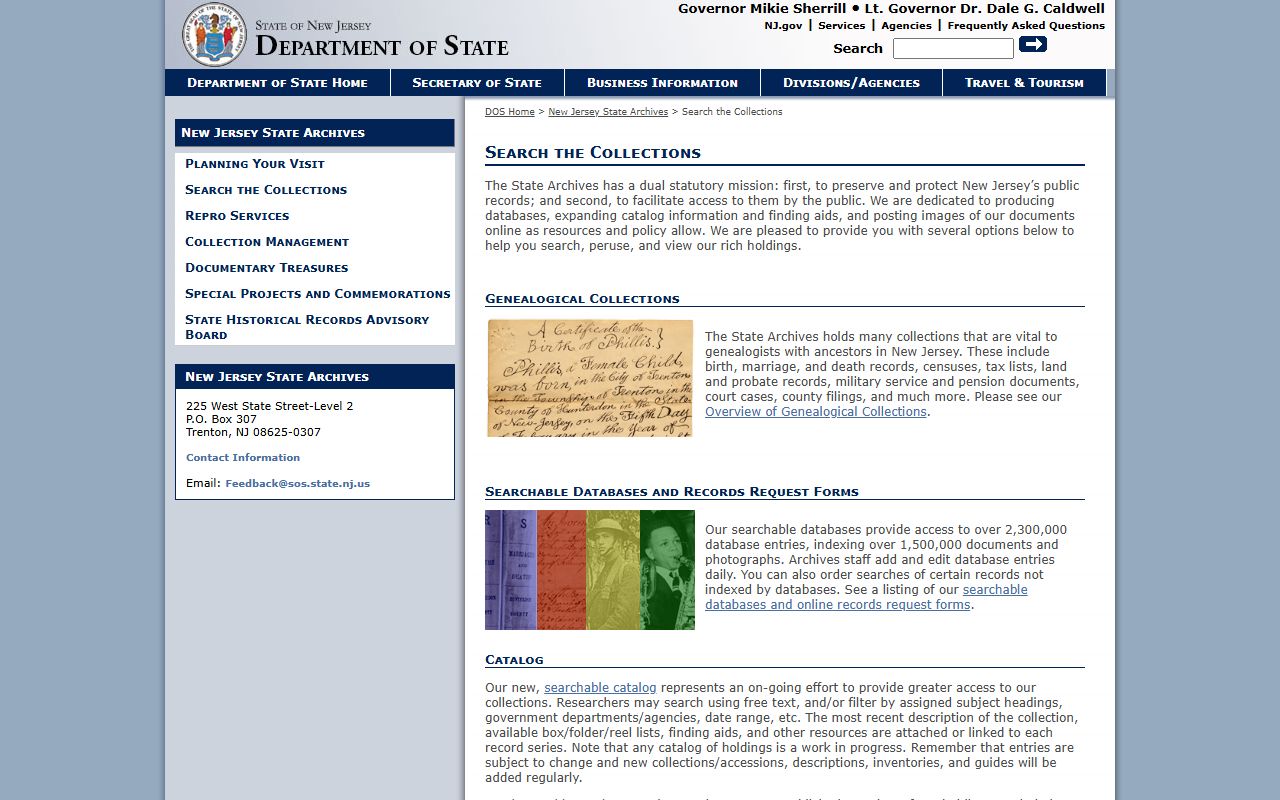
State Probate Abstracts from 1670 to 1817 have been carefully transcribed and indexed in volumes 23, 30, and 32 through 42 of the Archives of the State of New Jersey. County-level recording of wills and estate inventories began in 1804 at most Surrogate's Courts. The Archives' searchable catalog lets you search by record group, county, date range, and subject. It holds nearly 200 pre-set searches of holdings organized by type.
Most estate papers were first filed with County Surrogate's Offices starting in 1785. The State Archives has microfilm copies of many of these county records up to 1900, and into the early 1900s for some counties. Copies of wills starting from 1804, divisions of estates, guardianships for minors, and administrations of intestate estates are all part of the collection.
Probate Court Record Fees in New Jersey
Fees for probate court records are set by New Jersey law. They are the same in all 21 counties. The standard fee to probate a will is $100 for the first two pages, plus $5 for each extra page. Administration of an estate costs $125. Each Surrogate's Certificate costs $5. Filing a complaint or accounting with the court costs $175.
When you request copies of probate court records from the State Archives, the Probate Search Request form covers a search of up to five years. The fee includes copies up to 10 pages. Extra pages cost more. For certified copies, there is an added $25 per record fee. The Archives takes credit cards, checks, and money orders.
Are Probate Court Records Public in New Jersey
Yes. Probate court records are public in New Jersey. Once a will is admitted to probate, it becomes a public document. Under N.J.S.A. 3B:3-26 and the New Jersey Open Public Records Act (OPRA), N.J.S.A. 47:1A-1, most probate files can be viewed by anyone. You do not need to be a family member or have a legal stake in the estate. Visit the county Surrogate's Court or the State Archives to view records.
Some records have limits. Guardianship documents may be sealed under N.J.S.A. 3B:12-1 et seq. Adoption records processed through the Surrogate's Court are also sealed. But standard probate court records like wills, administration letters, and estate inventories remain open to the public across New Jersey.
The New Jersey Department of State oversees the Division of Archives and Records Management. The Archives works under a dual mission: to preserve public records and to make them available. They create databases, expand catalog data, and post document images online to help people access probate court records.
Browse Probate Court Records by County
Each county in New Jersey has its own Surrogate's Court that keeps probate court records. Pick a county below to find local contact info and resources for that area.
Probate Court Records in Major New Jersey Cities
Residents of major cities file probate cases at their county Surrogate's Court. Pick a city below to learn about probate court records in that area.